BRINGING ÆTHELSTAN BACK TO KINGSTON
History is often a mixture of fact and myth each giving us a way of looking at the past, and where not supported with direct evidence, fact often gives way to myth. The story of Kingston’s Coronation Stone, and the understanding of its very being, is no different.
This story not only concerns the Coronation Stone, it takes Into account the crowning of King Æthelstan, and his rise to power beginning at the site of that very stone, and more importantly, it concerns the story of Kingston and its place in history.
Many people believe that KINGSTON is named after the Coronation Stone – it being the ‘KING’S STONE’. Hence Kingston. Not so. The name KINGSTON comes from the Olde English words cyninges & tun (Cyniges tun) meaning the king’s manor or estate.
Interestingly, the name ÆTHELSTAN derives from the Old English Æðelstān meaning NOBLE STONE. So already there’s a connection between the Coronation Stone and the first King of all England to be crowned upon it.

Coronation Stone in the Guildhall garden at Kingston upon Thames
ENGLAND – A POTTED HISTORY – 1066 & BEFORE
The departure of the Romans from England at the beginning of the 5th Century brought about the advent of the Anglo-Saxons, which eventually led to the creation of the English nation as we know it today. But from 500 onwards, England was made up of disparate Anglo-Saxon kingdoms, each ruled by its own family of kings. Then in the late 8th Century, the Vikings arrived to settle, trade and raid, and seeing the plunder to be gained in our fair land, brought with them larger armies with the intention of conquering territory and constructing settlements. So by the time we get to the reign of King Æthelstan in 924, the Vikings were all powerful in middle England, with the Saxon kingdoms at war with the Vikings – and each other.
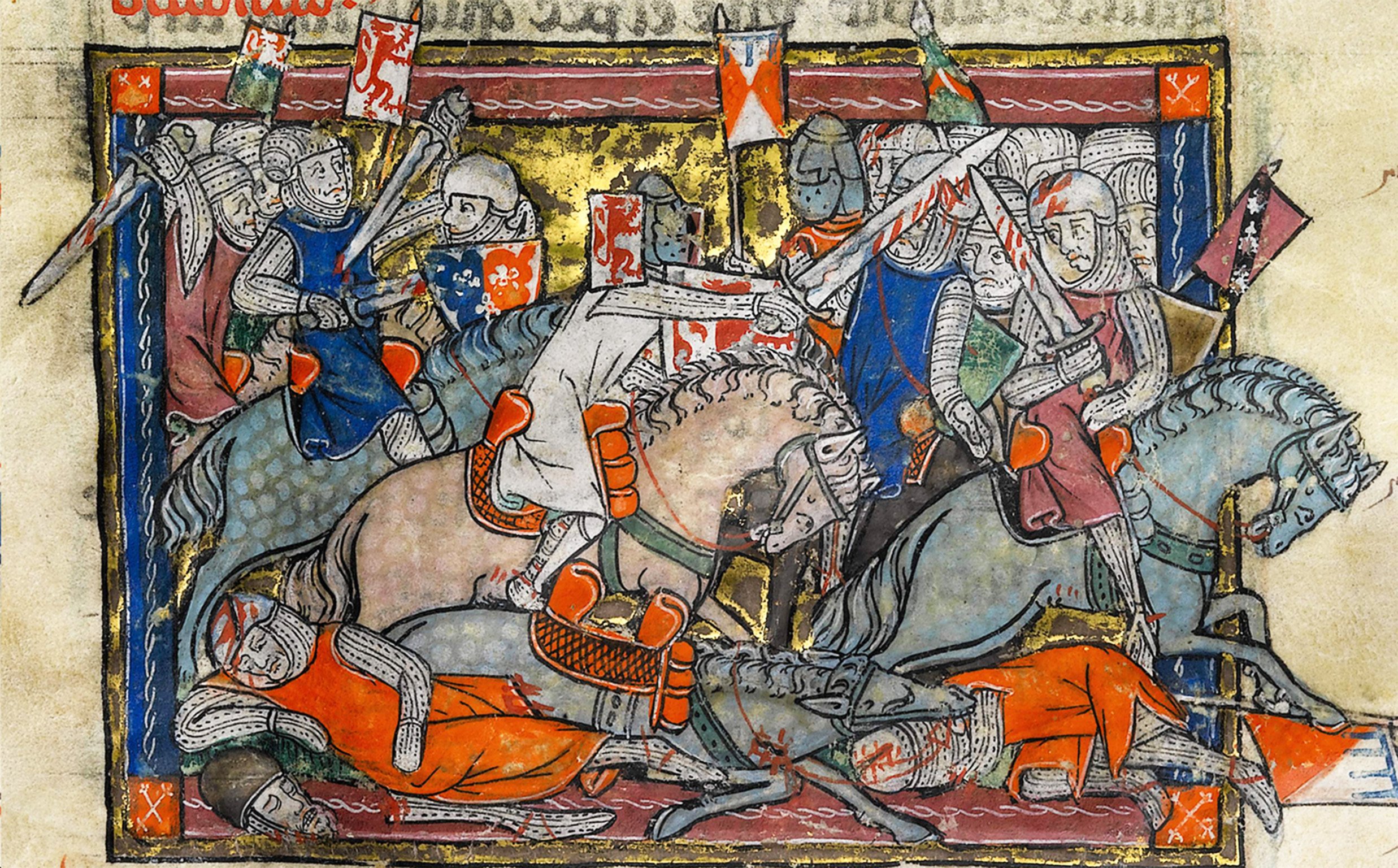
Saxons fighting Saxons (from The Rochefoucauld Grail)
The importance of King Æthelstan’s place in the history of England, his choosing of what was to become Kingston’s Coronation Stone, and indeed the geographical relevance of Kingston upon Thames, should not be underestimated, as Kingston provided the foundation for all that England is. And going back to the 9th Century, it’s location at a natural river crossing on the border between the Saxon kingdoms of Wessex and Mercia, made it the ideal location to hold important ceremonies and to crown its kings.
After his coronation in Kingston in 925, Æthelstan was to show his prowess not only as a warrior and leader, but as an instigator of change, enabling him to defeat the Vikings and unite the warring kingdoms. This legacy gave Kingston the leave to proclaim Kingston as the town where England began.*
*Now this may be a contentious claim, but it depends how you view the history of England and the events which created it. For we who live in Kingston, this is important, and until someone has a better claim, we’ll take it. And looking at an England from outer space, who’s to say that Kingston wasn’t the place where England began?
However we’re getting ahead of ourselves here. Going back to the death of his father, King Edward, in 924, Æthelstan became King of Wessex and Mercia – Wessex to the south of the River Thames and Mercia to the north – but the actual coronation was not to take place until the following year.
Although Edward’s coronation was in the small Saxon chapel at the top of the market place in Kingston (900), Æthelstan wanted his ceremony to be seen by the people rather than the chosen few. So he elected to have his ceremony in the open, in front of the chapel.
Æthelstan also wanted the ceremony to be one of importance and in a manner no lesser in religious significance and piety than all those kings who came before him – both in Briton and indeed, across the whole of Europe. And that meant finding a suitable symbol with holy and religious connotations around which this important ceremony would be conducted.
oOo
THE STORY OF STONES WITH MYSTICAL QUALITIES
At the time of Æthelstan, it was well known that the kings of Scotland, and before that, the kings of Ireland, were crowned on the Stone of Destiny, which was the stone upon which Jacob, feeling tired, laid his head on at a place called Bethel (some 20 miles north of Bethlehem), and where he dreamt he was greeted by angels, and was spoken to by God. (Genesis 28: 10-17)
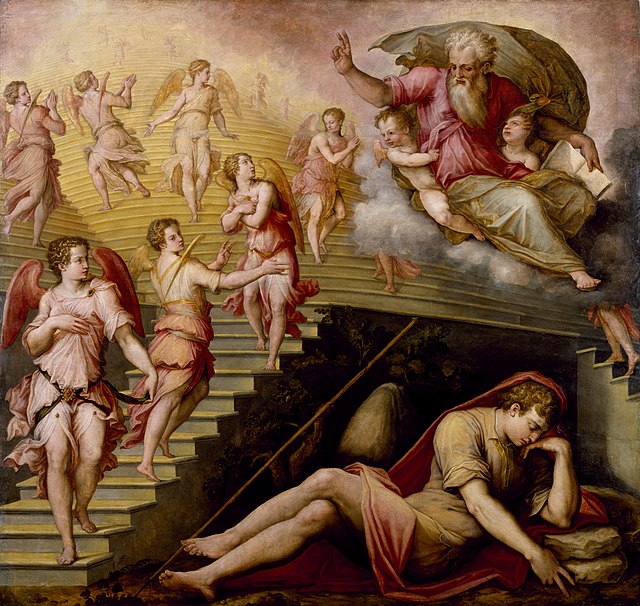
Jocob’s dream – A ladder appears brought by angels.
As a result of Jacob’s dream, the stone was blessed with holy oil and became known as Jacob’s pillow or pillar. According to Jewish legend, it became the pedestal of the Ark of the Covenant – molded after God’s actual throne – in the Holy Tabernacle, until Moses entrusted it to the Athenian prince Gathelus around the year 1000 BC (give or take 500 years), after which it found its way to Portugal, and then Ireland, where the ancient kings of that country were crowned upon it. At this point it was known as the Stone of Destiny. Thence it was captured by Celtic Scots upon the orders of their chief, Fergus, son of Erc, and taken to Dalriada in the west of Scotland where it became integral to the coronations of the Scottish kings. After some time, the stone was taken to Scone Palace in Perthshire where it remained until 1296 when King Edward 1 arrived to capture it and take it to Westminster Abbey. There it sits under the coronation throne, and subsequently all the kings and queens of England have been crowned upon it. And now it will be present at the coronation of our present king, King Charles III.
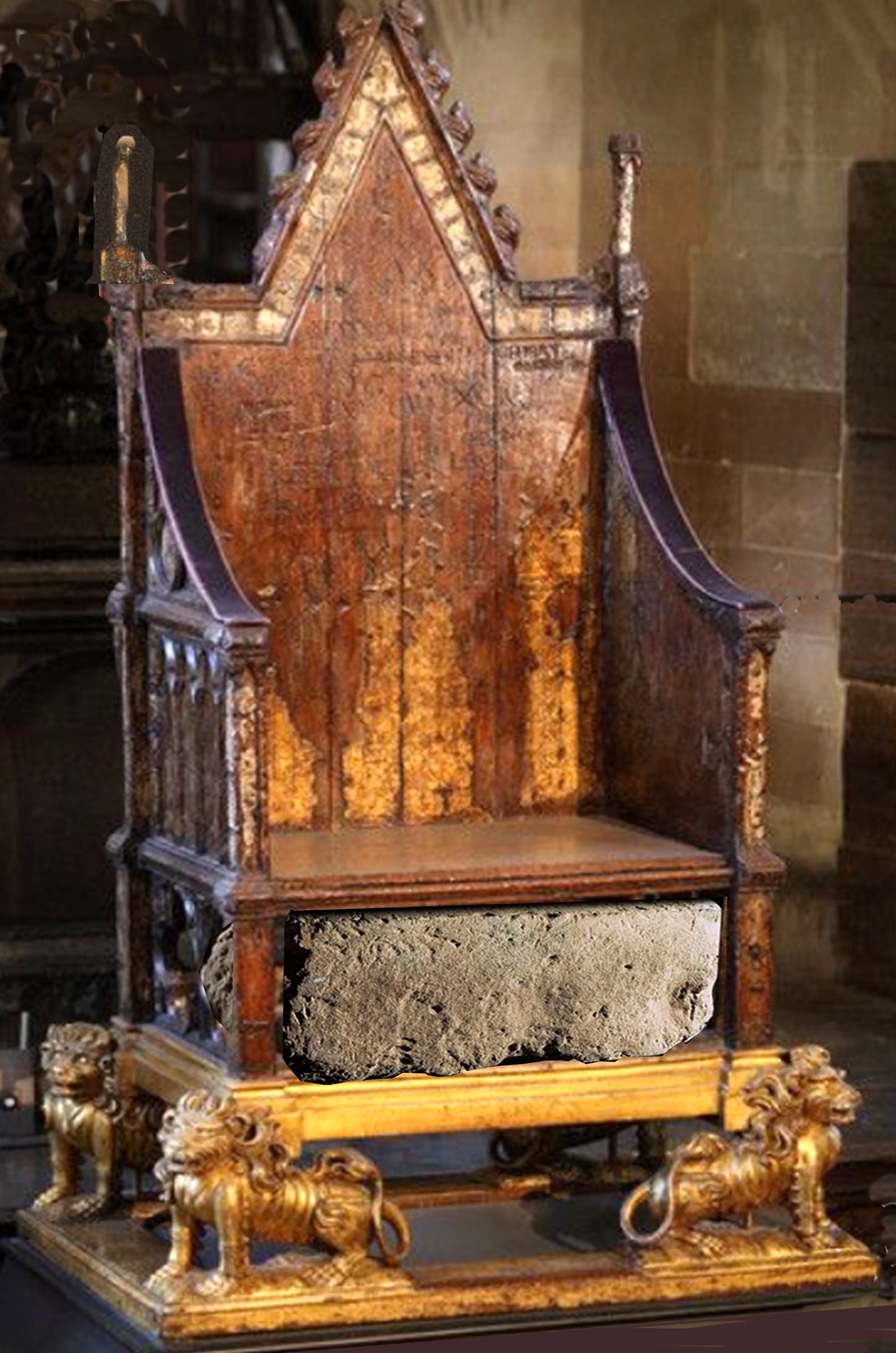
The Stone of Destiny sits under the Coronation Throne – Westminster Abbey.
Although the media of today call the Westminster stone, aka the Coronation Stone, the Stone of Destiny, it is also called the Stone of Scone because Scone Palace was where King Edward commandeered it. Strangely, when the stone was scientifically analysed, it was discovered to be of a sandstone mined from a quarry local to Scone, in Scotland!
So what happened to the original Stone of Destiny, you might well ask? Well, the wily Scots would tell you that in the year 1296, when they heard that King Edward and his army were coming for the real Stone of Destiny, the monks at Scone Palace hid the stone in the River Tay, or buried it on Dunsinane Hill, and the English troops were tricked into taking a copy.
oOo
GOING BACK TO OUR STORY
But in the year 924, the Stone of Destiny was in the hands of the bitter enemies of the Saxon kings, the Scots, and there was only one well known sacred site in Saxon England where stones had holy and mystical qualities – stones suitable for a new king’s coronation – and that was Stonehenge.
It should be remembered that we in the 21st Century have the benefits of ultrasonic and other diagnostic tools for the testing of ancient monuments and stones, whereas in the 10th Century, the only knowledge they had was that of myth and storytelling, handed down from generation to generation.
So at that time in the 10th Century, it was believed that the stones of Stonehenge had been erected by the magician Merlin, under the orders of Uther Pendragon, the father of King Arthur. And that they were stolen from Ireland where they originally formed ‘The Ring of Giants’, a sacred stone formation believed to possess medicinal healing powers. It was also said that there was not a stone amongst them which did not have some kind of supernatural, religious power.
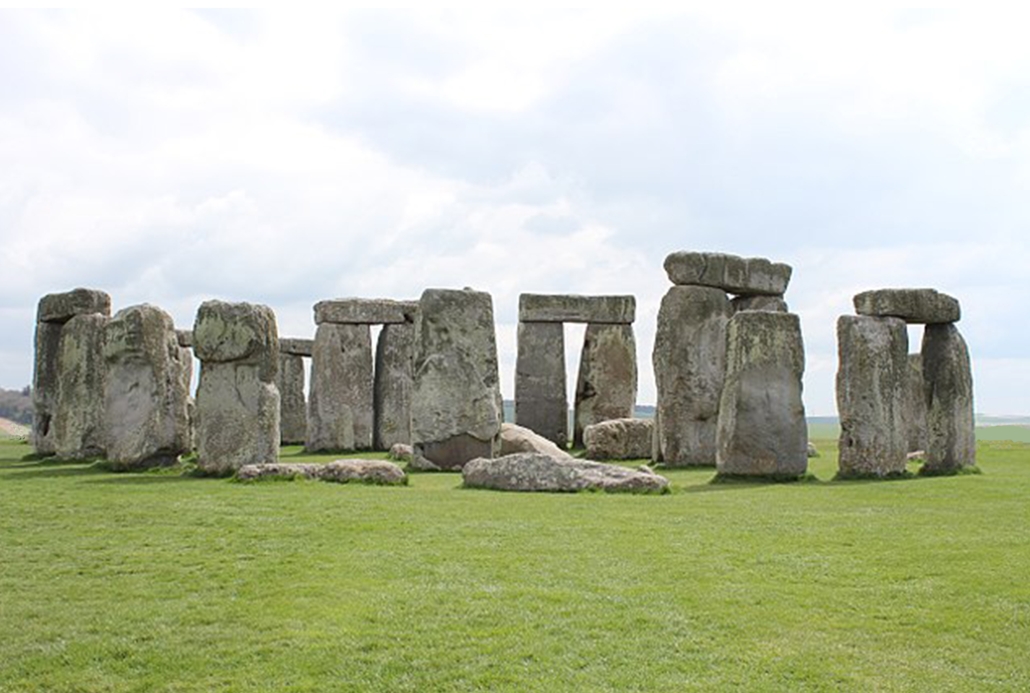
Stonehenge
(The significance of King Arthur and Merlin at the time was important from a religious aspect, because it was King Arthur who sent his loyal knights in the search of the Holy Grail – the cup which Jesus drank from at the last supper – and thus Merlin’s association with Stonehenge gave it a Christian heritage. This is relevant because Æthelstan was a devout Christian. The idea that Stonehenge was a Pagan site came about much later in the Victorian era.)
“Thus Merlin travelled to Ireland, accompanied by Uther and his army of fifteen thousand men, and after a fierce battle in which they defeated the Irish kings, they were faced with the impossible task of moving the giant stones. However, after much ado, Merlin ordained the help of giants to carry away the stones and load them onto ships. The stones were transported back to England, where orchestrated by Merlin, they were set up in a circle by the giants, exactly as they had been arranged on Mount Killaraus in Ireland.”
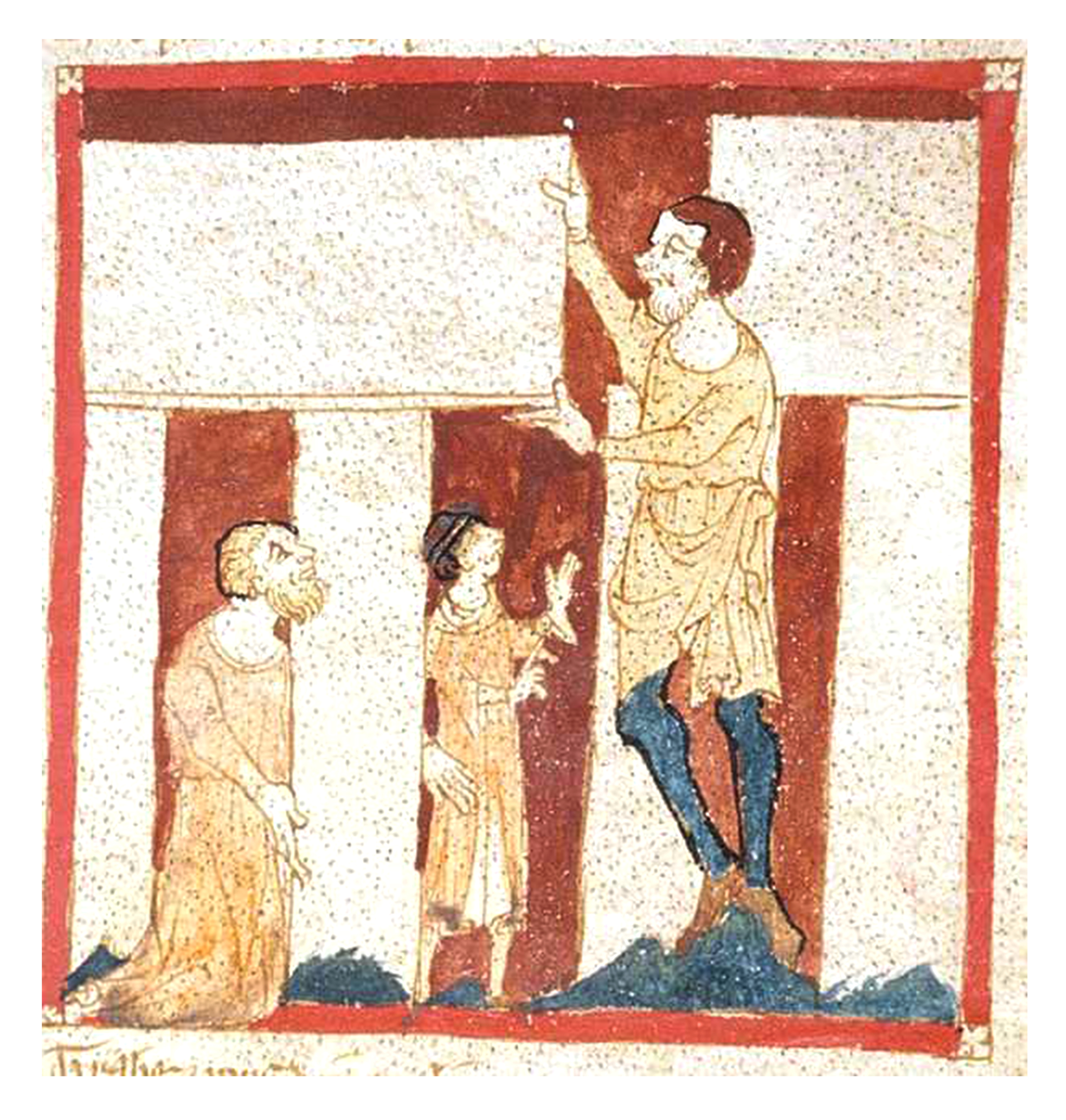
Giant helps Merlin build Stonehenge – The oldest image of Stonehenge – British Library -14TH Century
So in late 924, after he became King, Æthelstan accompanied by the Archbishop of Canterbury, Athelm, travelled to Stonehenge to choose a suitable stone for his coronation. A stone with qualities, which like his name meaning “Noble Stone” would be the link between the king, common man, and God.
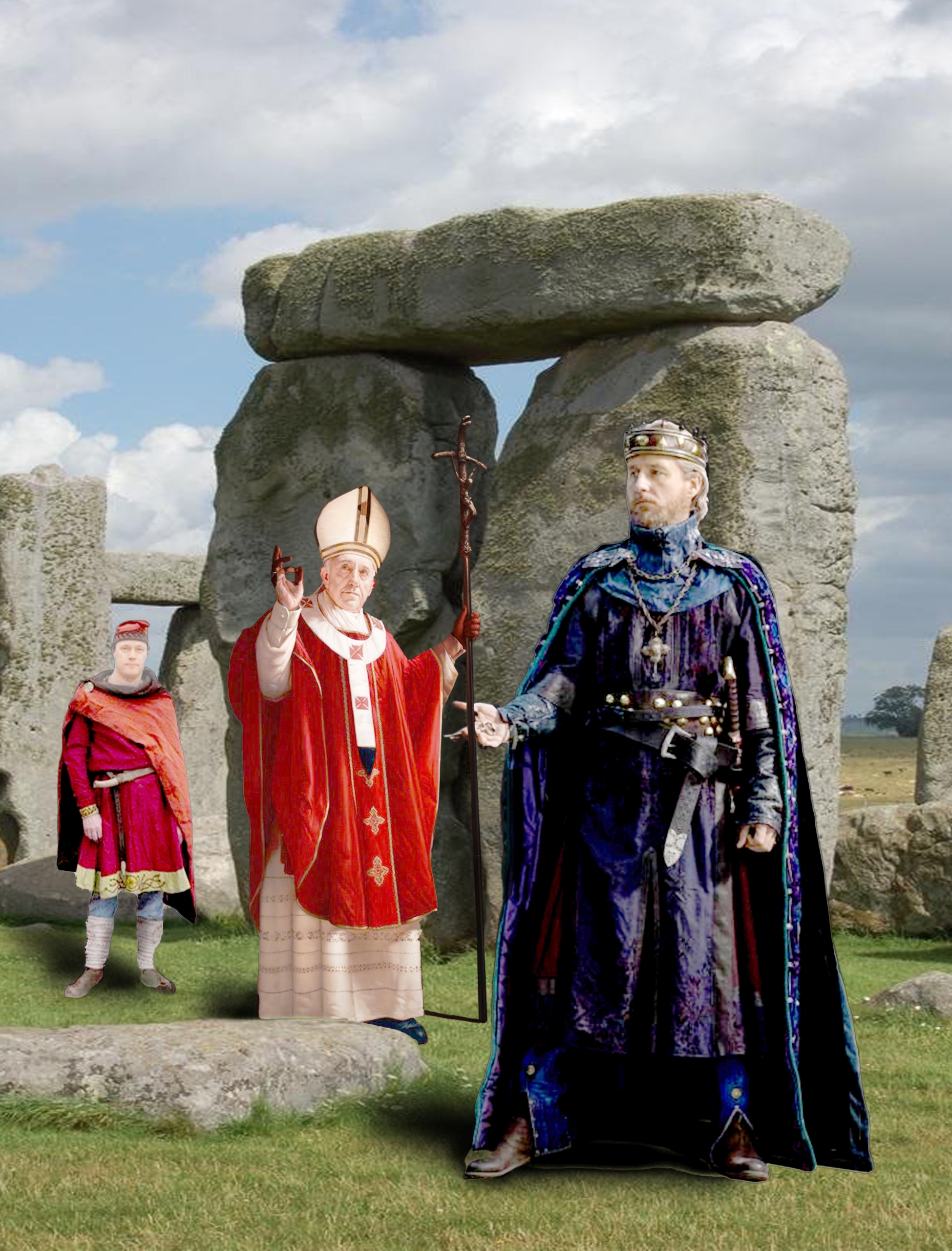
Æthelstan, accompanied by the Archbishop of Canterbury, Athelm, chooses a suitable stone for his forthcoming Coronation.
(Another important change at Æthelstan’s Coronation without precedent in the accession ceremonies of English kings, was the introduction of a crown in the ritual, taking the place of the traditional helmet. And this tradition of placing an actual crown on the new king or queen’s head, has been followed at coronations in England ever since.)
After the ceremony ordaining Æthelstan as king, the Coronation Stone was moved into the chapel at the top of the market place for the crowning ceremony of King Edmund in 946, King Eadred in 946, King Edwy The Fair in 956, King Edward the Martyr in 975 and Ethelred the Unready in 978, and the stone remained there until the Chapel collapsed in the year 1730.
KINGS CROWNED ON KINGSTON’S CORONATION STONE

One more point of interest about our Coronation Stone: the other Coronation Stone, the one under the throne in Westminster Abbey, may well be a fake, (well it certainly isn’t the stone which Jacob fell asleep on), but Kingston’s Coronation stone has been scientifically examined and is of Sarsen sandstone – which is the exact same sandstone that forms the major part of Stonehenge. And those stones came from a nearby site called West Woods in Wiltshire.
So we can safely say that Kingston’s Coronation Stone is the real deal.
AN IGNOMINIOUS END?
Following the collapse of the chapel, the Coronation Stone was moved back into the market place where for the next 100 years or so, it was used as a block for mounting horses.
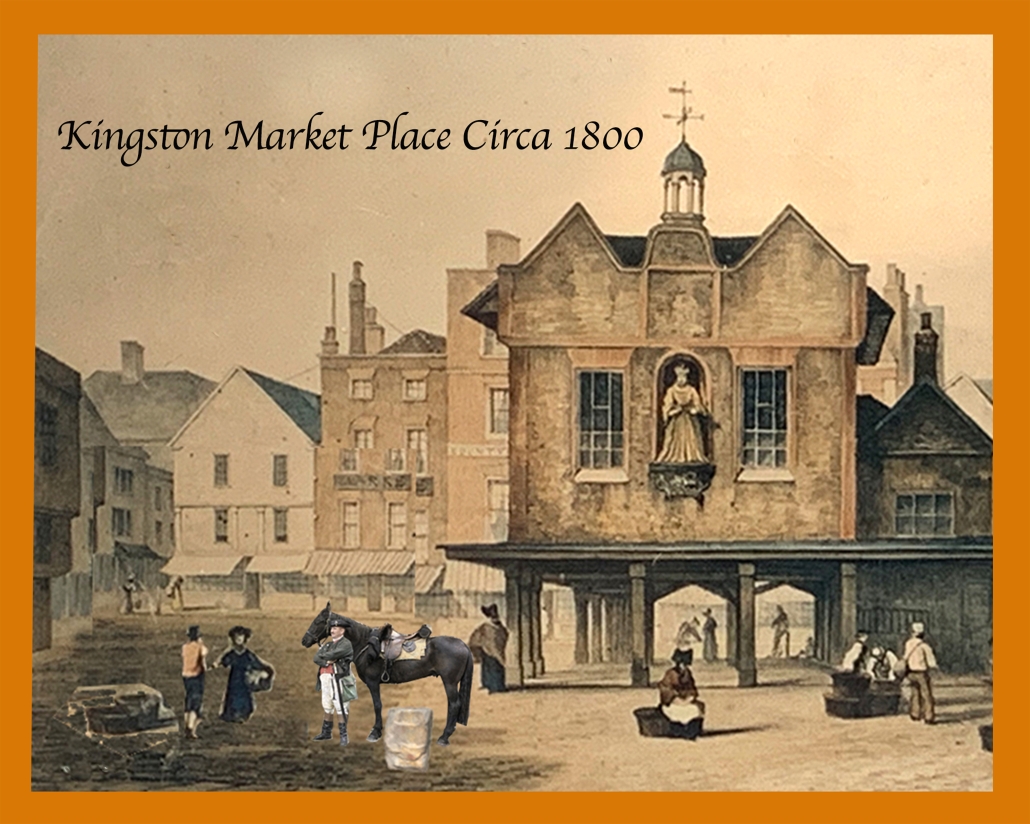
Mounting block in the Market Place
SALVATION
Subsequently in the year 1850, the Coronation Stone was recognized as an object of importance, and given a place of pride, surrounded by blue railings, just south of the market place. It stood there until 1935, when it was moved to its present location in the corner of the garden by the Guildhall.
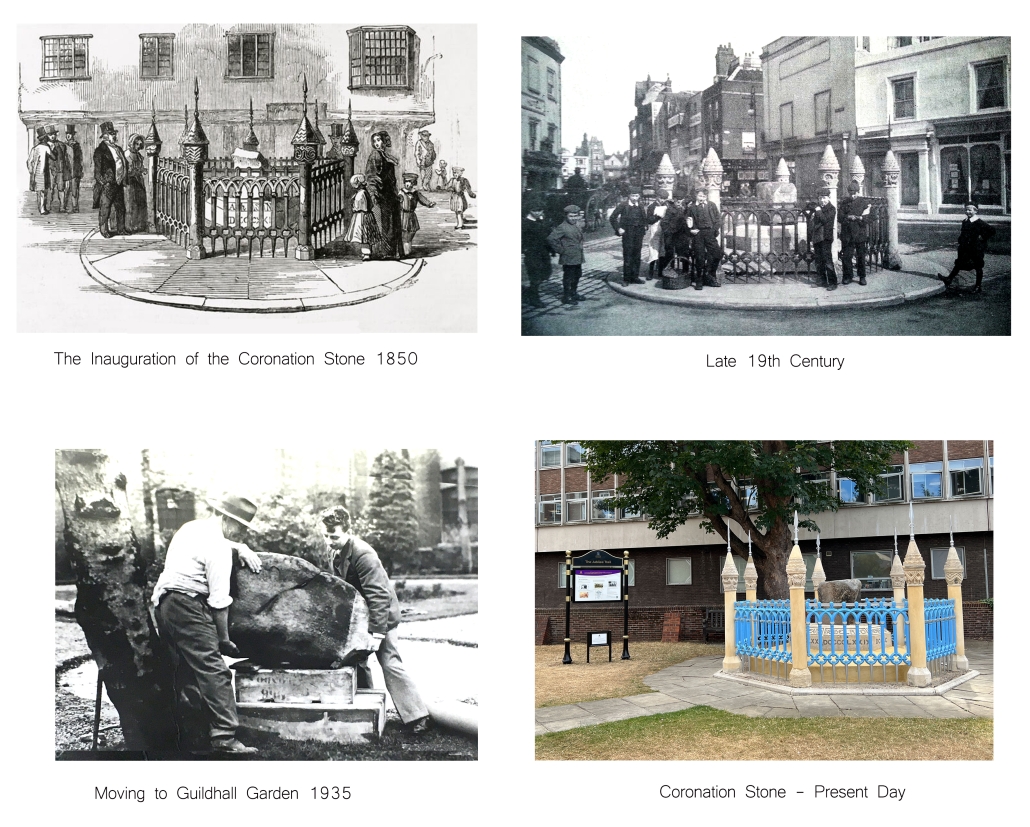
SO WHAT OF KING ÆTHELSTAN AND HIS ACHIEVEMENTS?
When Æthelstan was crowned in 925, he was only King of Wessex and Mercia. By 927, two years after his Coronation and after he had conquered the remainder of England, he held a meeting in Cumbria with the lords and Kings from as far afield as Scotland and Wales, all who vowed allegiance to him. As a consequence, all the kings of this island were brought under Æthelstan’s rule. And for years after, poets and chroniclers hailed Æthelstan as ‘rex totius Britanniae’ – the King of the whole of Britain.
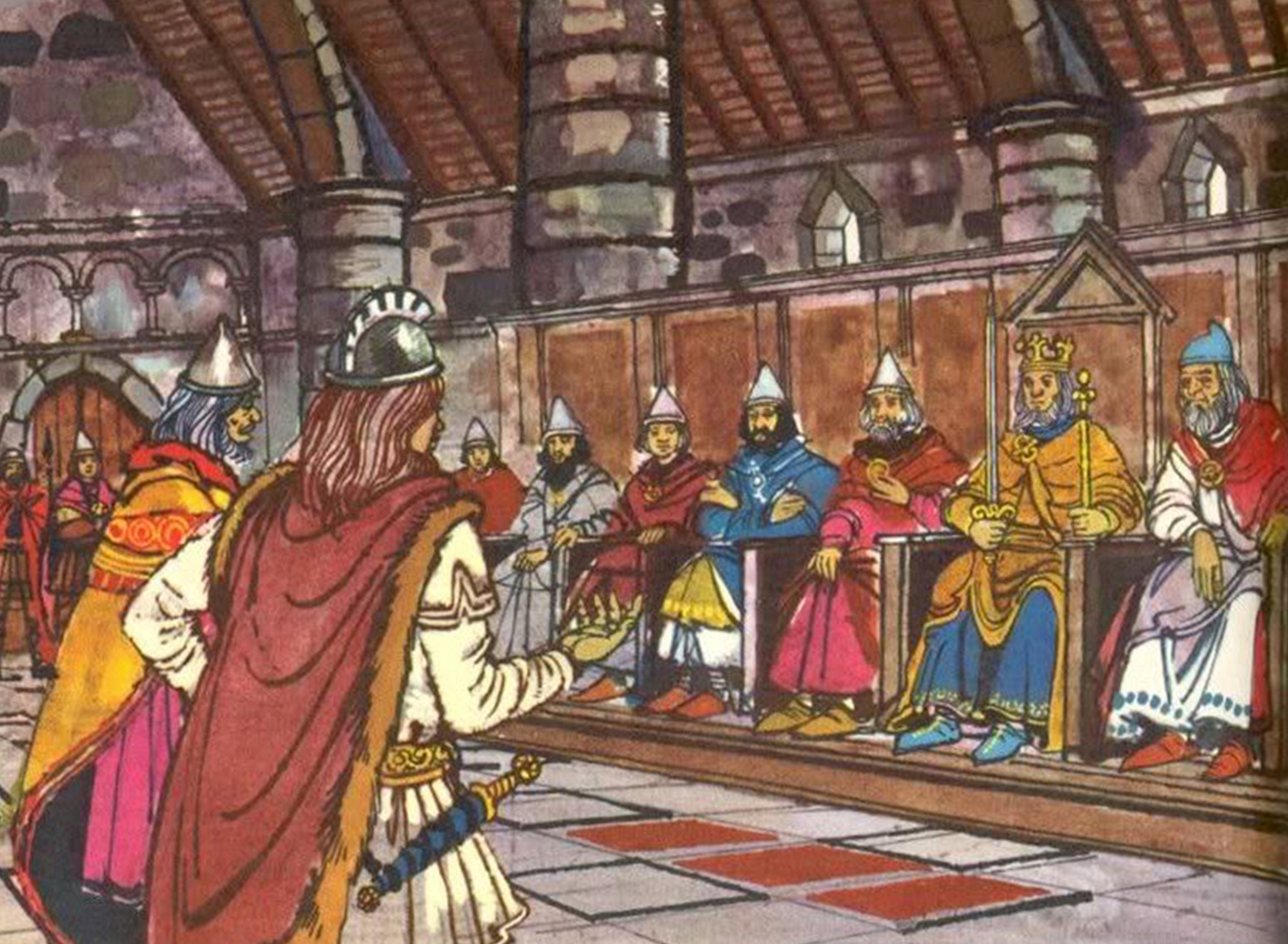
Regional kings and leaders swear allegiance to Æthelstan
COINS OF THE REALM

Coins of the realm
To celebrate his sucess, Æthelstan decreed that only the King’s head should be on the currency, whereas before, Bishops, Abbots and Barons were privileged to have their face on the coinage.
LEGISLATION
Æthelstan brought about the centralisation of government, which was the forerunner of our present system. He increased control over the production of charters, (the equivalent of Executive Orders we hear about in America), and he summoned leading figures from distant areas to his councils. His legal reforms built upon those of his grandfather, Alfred the Great.
Æthestan’s household was the centre of English learning, and it laid the foundation for the Benedictine monastic reform later in the century. No other West Saxon king played as important a role in European politics as Æthelstan, and he arranged the marriages of several of his sisters to continental rulers, thus forging important international allies. You could call it the forerunner of the European Union.
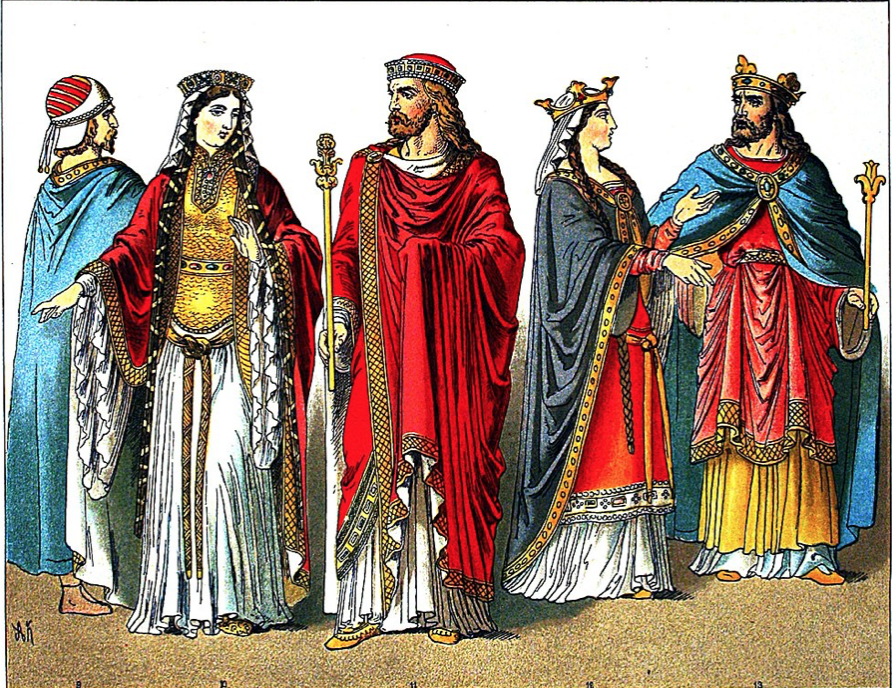
European Royalty
In addition to this, Æthelstan was one of the most pious of West Saxon kings, and was known for collecting relics and founding churches. His relics included the holy lance, also known as the spear of destiny, that pierced the side of Jesus at the crucifixion, as well as nails from the cross itself; another relic was the Roman Emperor Constantine’s favourite sword which he took with him to the Battle of Brunanburh.
THE BATTLE OF BRUNANBURH
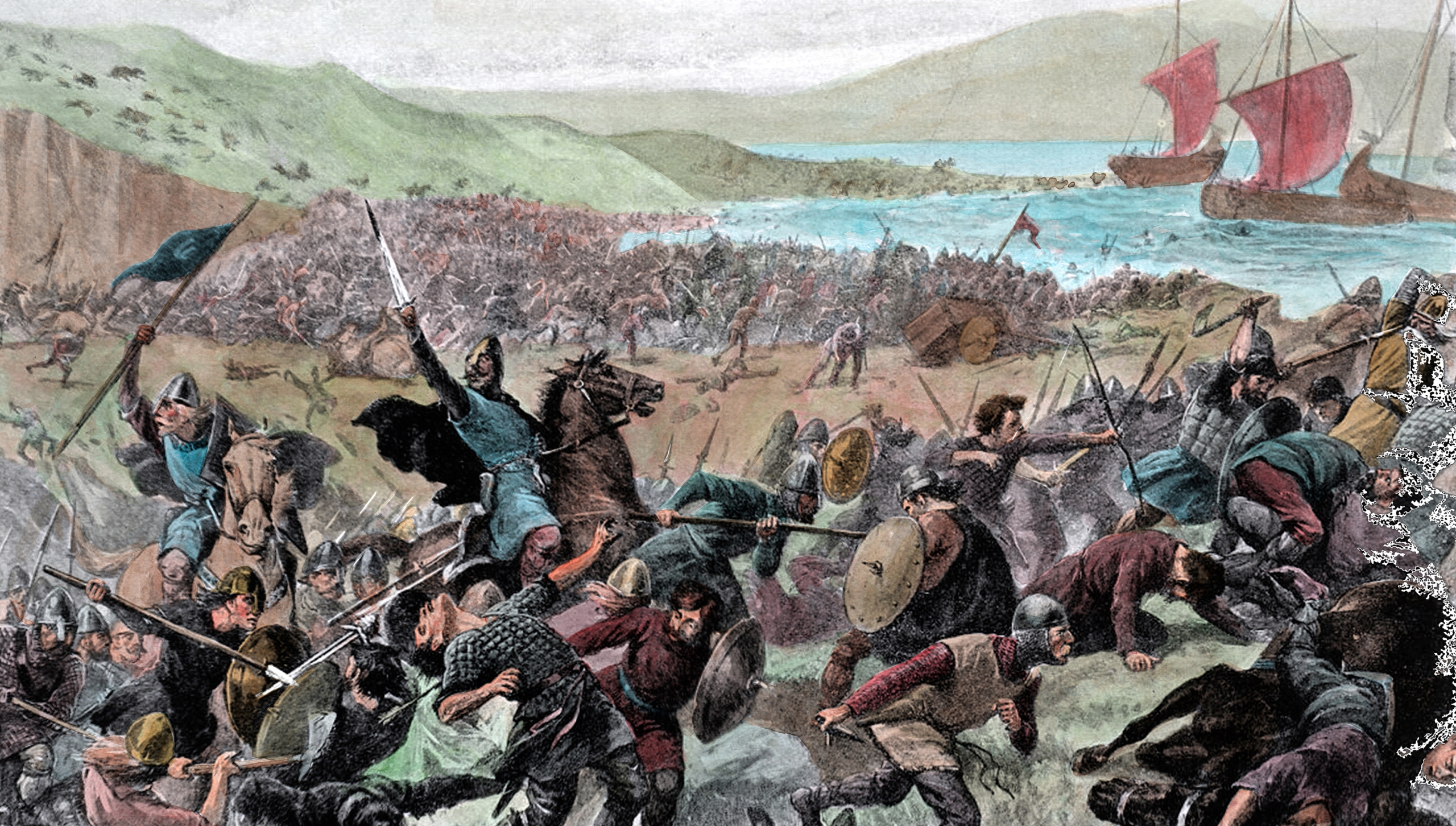
The Battle of Brunanburh
During the course of Æthelstan’s reign, several factions had clubbed together in order to unseat him, and in 937, a combined army of invading Scots led by King Constantine II, King Olaf of Ireland, and a thousand Viking mercenaries, travelled south to take on Æthelstan in battle. Individually Olaf and Constantine were too weak to oppose Æthelstan, but together they could hope to challenge the dominance of Wessex.
Medieval campaigning was normally conducted in the summer, and Æthelstan could hardly have expected an invasion on such a large scale so late in the year. Although he was slow to react, the ensuing battle at Brunanburh was one of the most important, yet bloodiest battles ever fought on British soil. The prowess of Æthelstan on the battle field and his victory over his assailants sealed his place as leader in Britain in the single and unified England, enabling him to hold on to the title of King of all Britain.
POEMS AND WRITINGS
Æthelstan’s victory preserved the unity of England. The historian Æthweard wrote around 975 that “the fields of Britain were consolidated into one, there was peace everywhere, and abundance of all things”. Alfred Smyth has called the battle “the greatest single battle in Anglo-Saxon history before Hastings. The poem Battle of Brunanburh in the Anglo-Saxon Chronicle recounts that there were “never yet as many people killed before this with sword’s edge… since the east Angles and Saxons came up over the broad sea”.
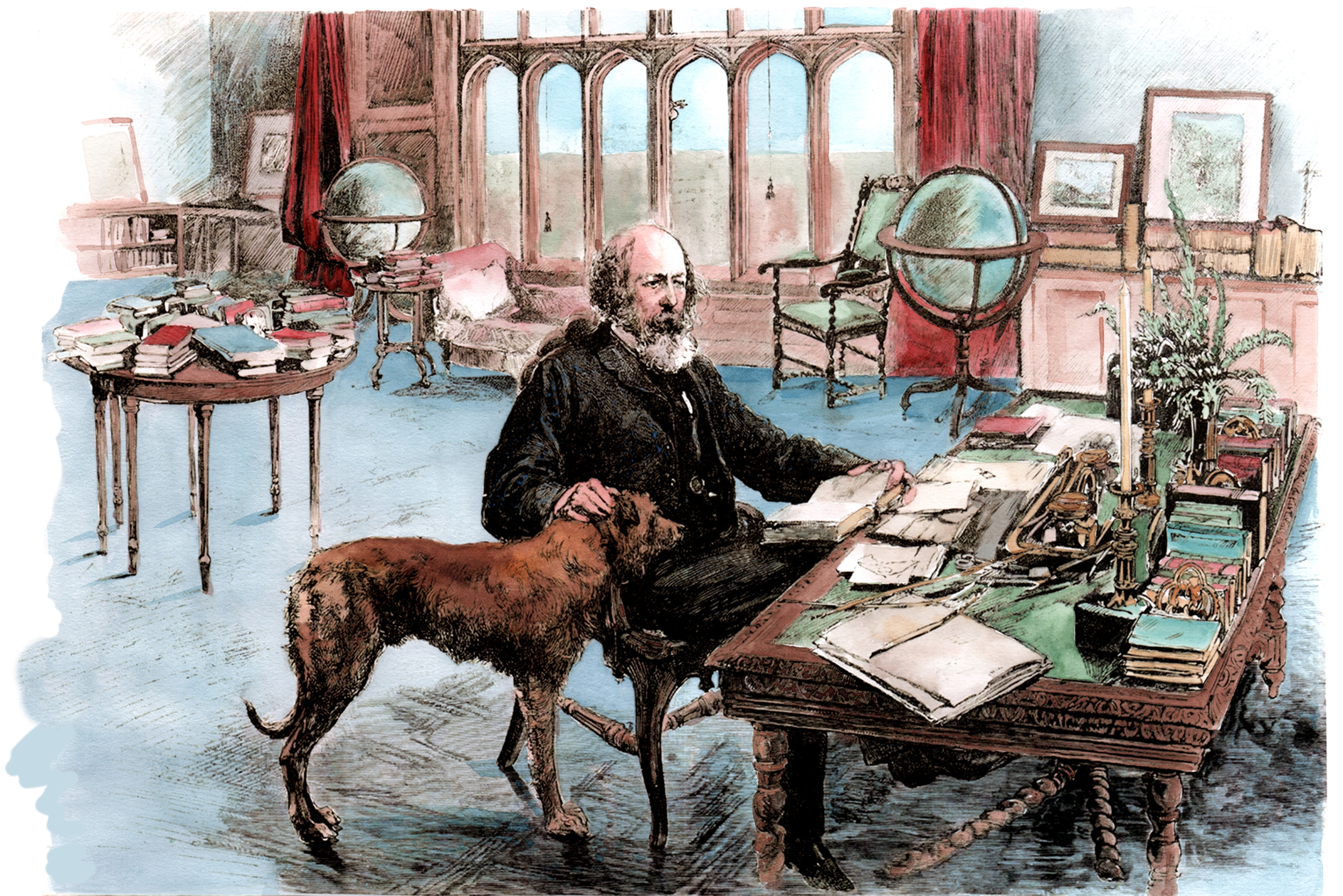
Lord Tennyson at his desk.
Lord Tennyson was to write in his poem – Battle Of Brunanburh….. Almighty the Meridian, Æthelstan King, Lord among Earls, Lamp of the Lord God, Glory in Battle, There by Brunanburh.
BRINGING ÆTHELSTAN BACK TO KINGSTON
Kingston upon Thames has obscure references to Æthelstan dotted around the town. There’s a colorful illustration in the passage leading to Charter Quay. There’s a wall plaque opposite Eden Kebabs in Eden Street. There’s even a small sculpture high up on the wall of a building in the Market Place – which hardly anyone knows about. And there’s a local school named after him. But nothing to inspire the soul, or to bring commerce or tourists into Kingston.
We believe that Æthelstan is so integral to the history of Kingston, that it is our duty to secure his place in Kingston where he belongs, so that the citizens of our great town can share his story and be proud of his achievements. To bring that about, we have proposed that Kingston has a unique bronze sculpture, to be placed in or near the market place where Æthelstan was crowned.
A WORLD FIRST
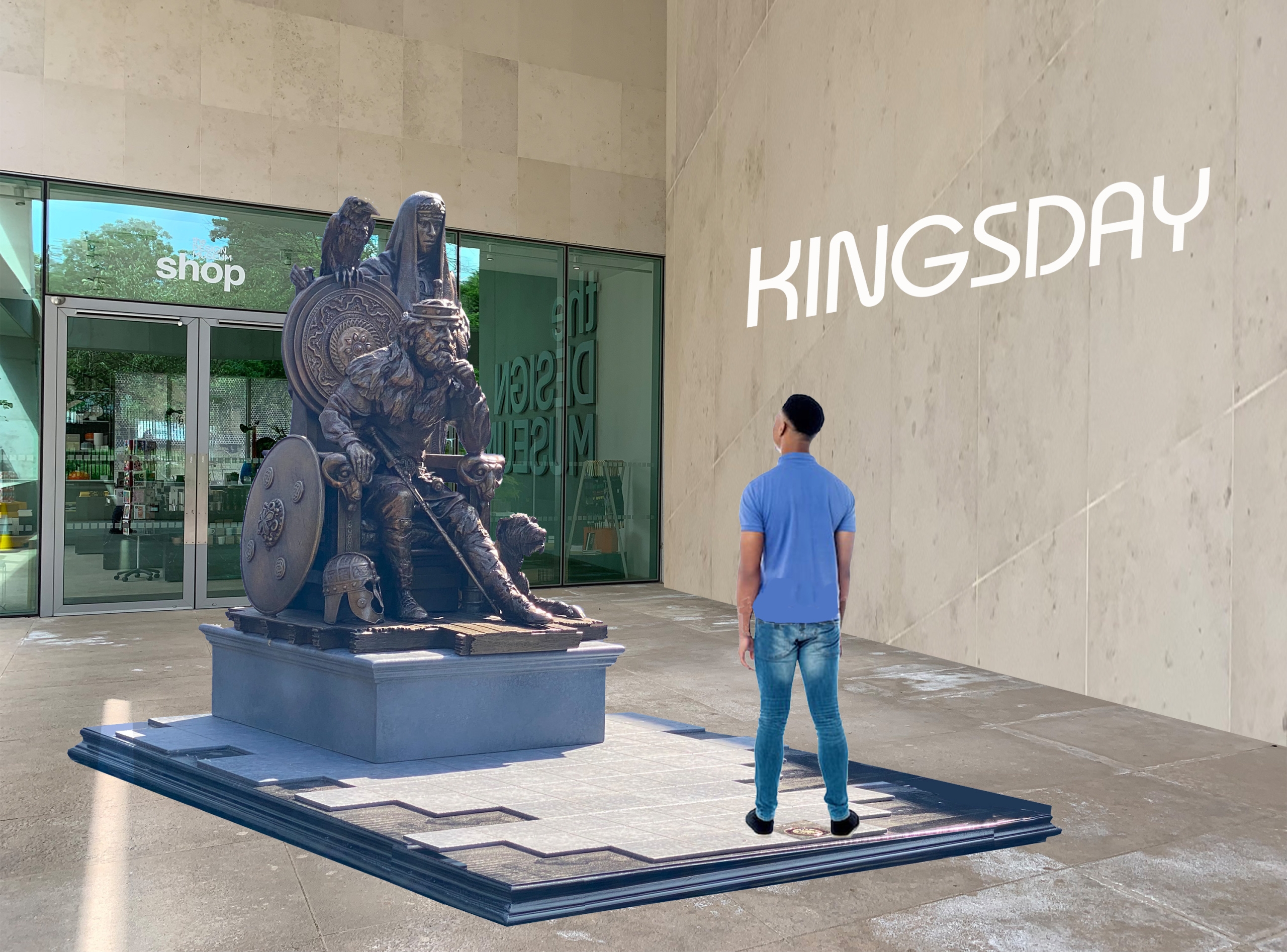
The proposed sculpture by award winning English figurative sculptor, Andrew Sinclair.
The intention of art is to inspire the viewer. But to achieve this, the viewer must engage with the art. And that takes time and effort and focus from the viewer. In general, the complexities of everyday life don’t allow for that, and to make the point, the average viewing time for a museum work of art is two seconds.
WHY OUR SCULPTURE OF ÆTHELSTAN IS DIFFERENT
There are some works of art where people travel great distances to see them. The Mona Lisa for example. We believe this sculpture will have the same effect.
It works like this: As the viewer approaches the sculpture, he or she is directed to stand on a spot marked by a bronze replica of a coin of Æthelstan’s reign, set in the ground in front of the sculpture.
As the eyes of the viewer travel upwards, they engage with the eyes of the four characters in the sculpture, and a powerful and exhilarating interaction takes place as all four characters stare the viewer in the eye.
IN THE HISTORY OF SCULPTURE, THIS HAS NEVER BEEN ACHIEVED BEFORE.
And when the viewer looks directly into the eyes of Æthelstan, he or she can actually feel the presence of a king, as he yields his meaning and exerts his power – the power of a man who as the first king of all England, sowed the seeds of what England was to become over the following centuries.
DESCRIPTION OF THE SCULPTURE
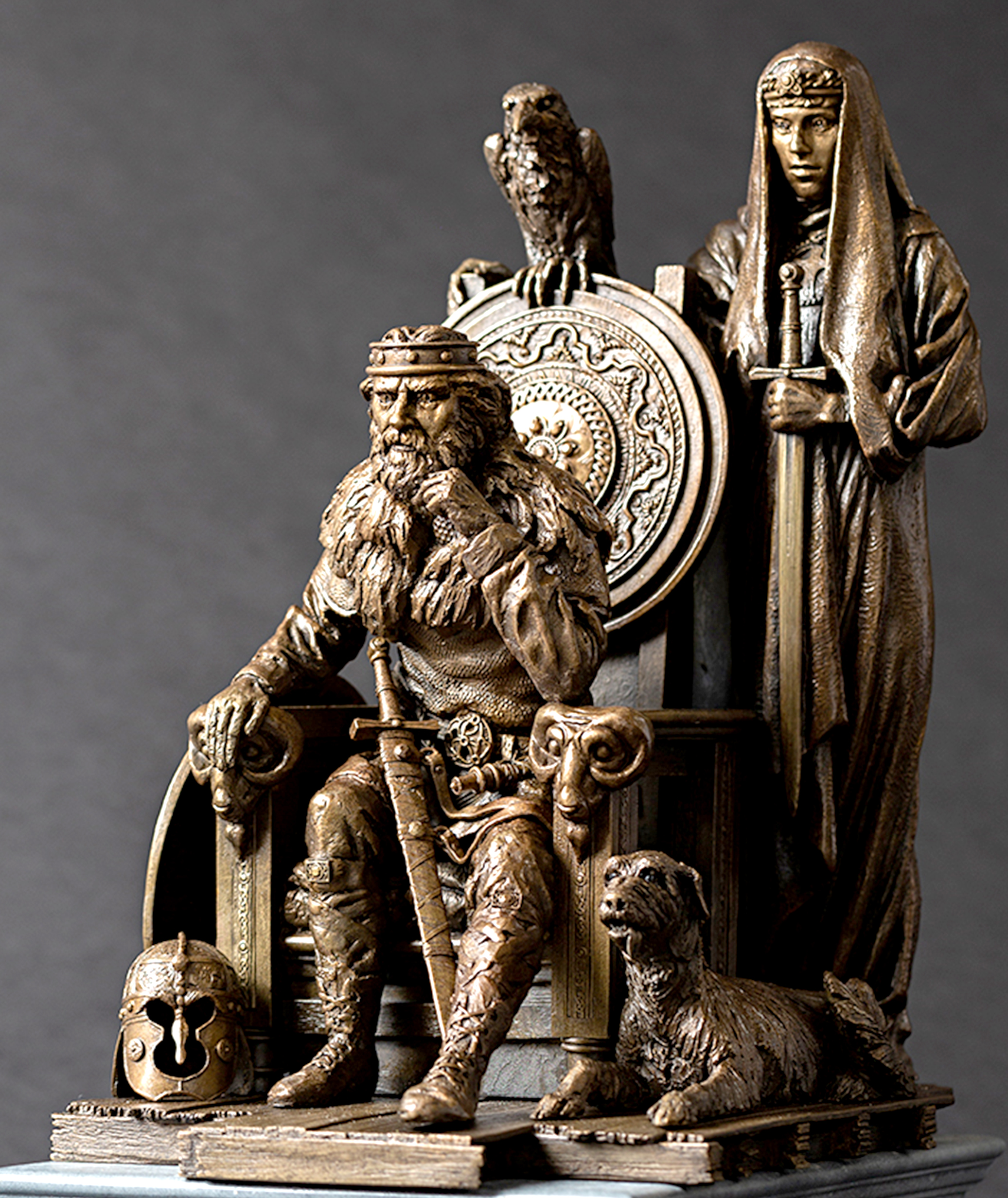
Æthelstan sits on his throne, leaning forward with focussed attention – sword between his legs in readiness. Behind Æthelstan sits Muninn, the Norse god Odin’s raven, mythical in culture, but physical in this work of art, encouraging the mind to question his presence. Next to Muninn is the ‘spirit’ of Æthelflæd – Warrior Queen of Mercia in the preceding years, daughter of King Alfred, and aunt to Æthelstan.
(We say spirit because at the time of Æthelstan’s reign, Æthelflæd was no longer alive. But coupled with the mythology of the Norse gods, and Odin’s raven, the influence of Æthelflæd was an integral part in the development of Æthelstan, as it was she who brought him up and taught him the arts of war, and more importantly, the arts of kingsmanship.)
ATTRACTING TOURISTS AND COMMERCE
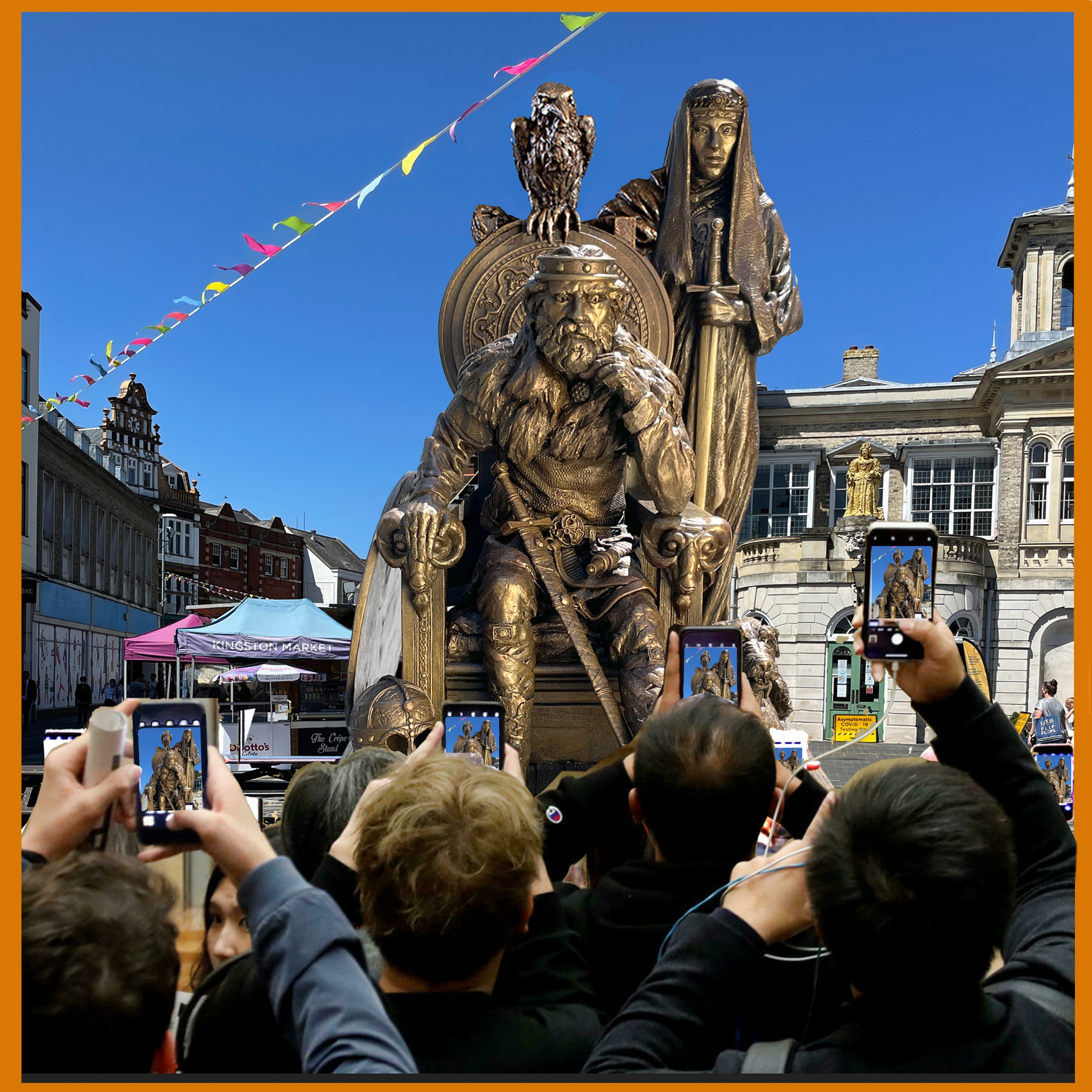
Crowds gather around the sculpture of Æthelstan
A brief walk around the sculpture, past Æthelstan’s battle helmet and shield, will bring the viewer to the three figurative plaques set in the back of the throne, each one revealing an important phase in the life of Æthelstan. And further round beside the throne, Ægir, Æthelstan’s faithful hound, lying there with panting tongue, so realistic in creation that the viewer will want to whistle for him to follow them home.
The definition of great art is that it changes us. In its interaction with the viewer, this sculpture will cause the viewer to enquire about the relevance of the characters, examine its creation and learn about its history, thus becoming part of the story themselves. A story which they will want to share with their friends and loved ones.
It will encourage education and knowledge, which will inspire tourism, commerce and diversity – thus placing Kingston on Thames firmly in the history books and tourist maps, as an extremely important place to visit
in modern day England.
A REMINDER OF WHAT KINGSTON HAS TO OFFER TODAY
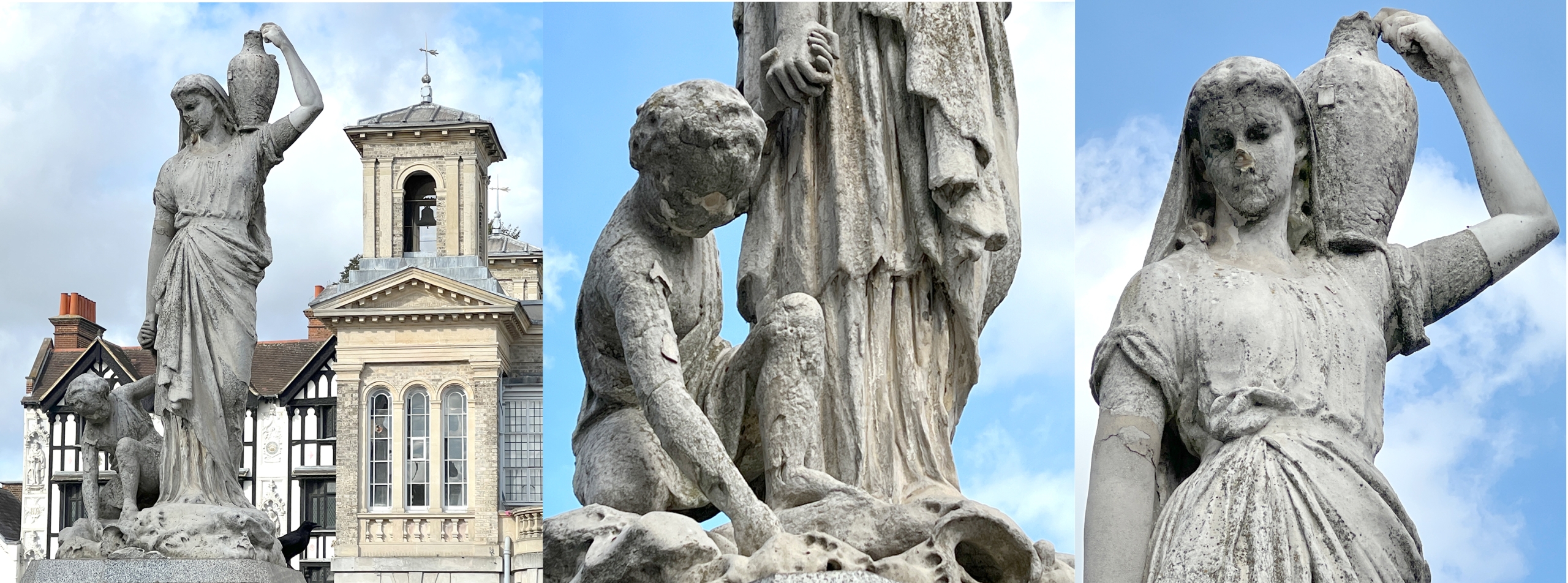
The eroded stonework of the Shrubsole Memorial
Although it might have sentimental value, the Shrubsole Memorial in the centre of Kingston’s Market Place is hardly worthy of representing Kingston. The nose has come adrift, the replacement arm looks exactly as it is – a replacement in different textured marble – and the remainder of the sculpture has eroded way beyond repair.
KINGSTON DESERVES BETTER.

Inextricably linked in the culture and story of Kingston – the Coronation Stone and Æthelstan.
NOW IS THE TIME TO BRING ÆTHELSTAN BACK TO KINGSTON
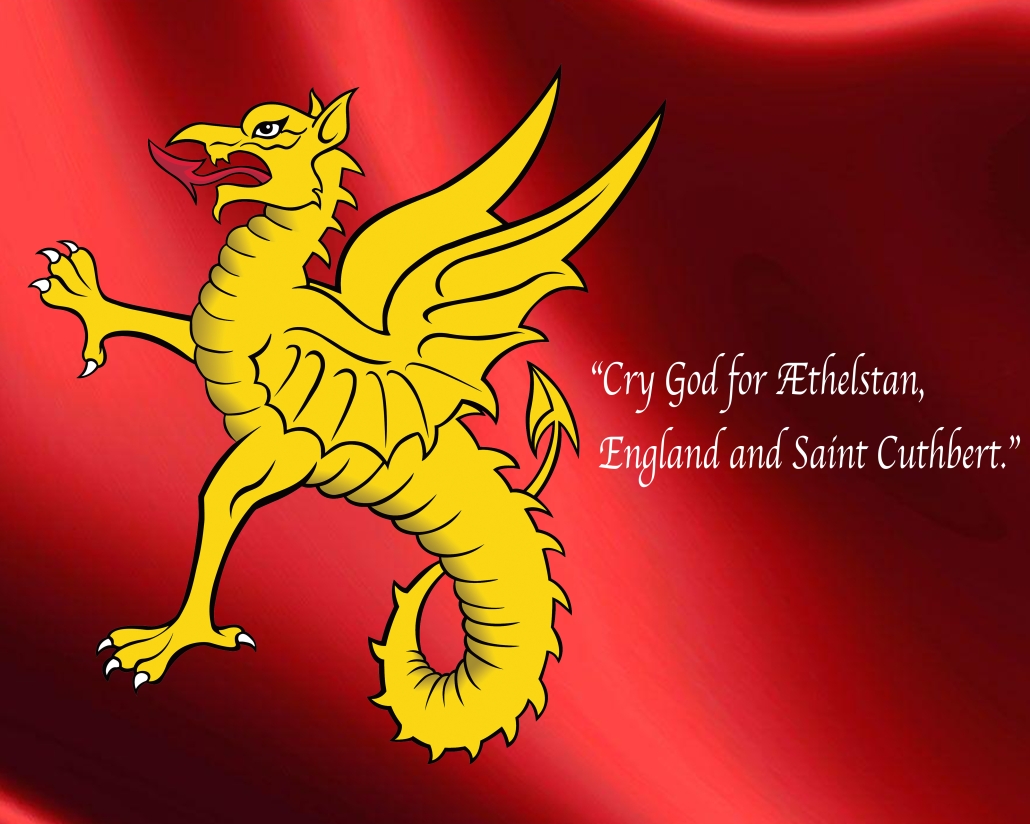
Shakespeare might well have written this.
For more information, write to: info@coronationstone.com